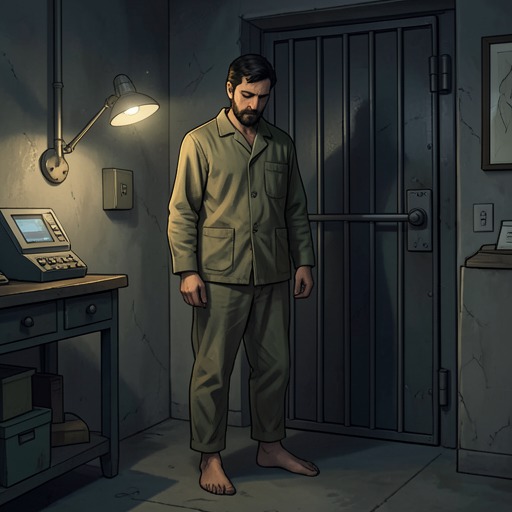
Sonny Lofthus’s heroin withdrawal
The SonSonny Lofthus’s heroin withdrawal is both a physical ordeal and a test of whether he can refuse the dependence that has shaped his life. In Staten Maximum Security Prison, he turns down drugs, endures the consequences of stopping, and asks to be locked in his cell because he knows that, in withdrawal, he may accept whatever is offered. His refusal also frustrates an attempt to use heroin to secure his signature on a confession, making abstinence an act of resistance as well as a personal struggle.
Withdrawal in Staten
Six days after a notorious interview, Sonny is enduring a difficult period in prison. Reports reaching Einar Harnes say that Sonny has not tried to obtain drugs and has rejected offers of speed and cannabis. Instead, he has spent hours exercising: two hours on a treadmill followed by another two lifting weights. Screams have been heard from his cell at night, but he continues to hold out. His exertion suggests an effort to endure the crisis by redirecting his energy; it does not make the withdrawal easy or establish that it has ended.
The signs of the struggle are also evident in Sonny’s condition. When he asks to be locked in, Goldsrud initially finds the request puzzling: other prisoners might seek protection from enemies, but Sonny has no apparent adversaries among the inmates, who treat him with exceptional regard. Goldsrud also knows that Sonny has shown unusual physical and mental stamina. He understands the reason only after noticing that the marks on Sonny’s arm have scabbed over and that there are no fresh ones. Sonny has quit using and wants the cell door secured because he knows he may take any drug offered to him while in withdrawal.
Pressure to Resume Using
Harnes approaches Sonny with a calculated bargain. He says that DNA evidence will secure a conviction whether Sonny confesses or not, and urges him to sign papers rather than prolong the process. When Sonny does not respond, Harnes says he can bring him a bag of Superboy within an hour and insists that all he needs in return is Sonny’s signature. Sonny’s dry, cracked lips underline the state he is in, but he does not accept the proposed exchange; he says he will consider it.
The offer exposes how Sonny’s dependence can be turned into leverage. Harnes is not simply offering relief: he is trying to convert Sonny’s need into a confession. Sonny’s silence and refusal to sign preserve a measure of control in a setting where others are attempting to dictate both his choices and his account of events. His withdrawal therefore matters to the prison plot as more than a medical condition: it is the point at which coercive pressure meets a decision not to return to drug use.
A Deliberate Barrier
Sonny’s request to be locked up is a form of self-protection. He does not claim that he is safe from temptation; rather, he recognizes that withdrawal could make him accept whatever is available. The locked door would restrict his access to offers he expects he might otherwise take. His conduct combines a clear-eyed recognition of vulnerability with an active attempt to manage it.
That strategy contrasts with the way others read him. His standing among the prisoners and his history of endurance make his fear difficult for Goldsrud to understand at first. The reason is not an enemy outside his cell but the possibility of his own response to drugs. Withdrawal shifts the danger inward: Sonny is not asking to be protected from another prisoner, but from circumstances in which his dependence could overrule his intention to quit.
Persistence and Recurrence
The novel presents Sonny’s abstinence as a sustained effort, not a single declaration. He rejects several kinds of drugs, spends long periods exercising, and remains in withdrawal even when Harnes makes heroin available as an inducement. Later, Sonny gives Lars Gilberg a fifty-krone note and explains that the money is for him because Sonny has quit. The exchange carries the decision beyond the prison cell: Sonny’s claim to have stopped is expressed through an ordinary transaction, rather than through a dramatic announcement.
The surrounding criminal world continues to make abstinence precarious. Franck invokes the case of a prisoner who had worked for Hugo Nestor and was suspected of possibly talking; he describes a death in custody and the fear that a cell door might be unlocked from the control room. This account is not evidence that Sonny’s withdrawal causes that death, but it places his confinement within a prison where access and safety can be manipulated. Later, Sonny’s capacity for violence and his history of killing are invoked by Franck as he restrains him in the governor’s office. The contrast does not erase Sonny’s earlier struggle: the man who once sought a locked door to keep himself from taking drugs is also caught in a wider course of danger and retaliation.
Meaning and Limits of the Evidence
Sonny’s withdrawal makes the conflict between intention and dependence concrete. He recognizes that quitting does not immediately free him from the possibility of using; it creates a period in which he must actively guard against that possibility. His choice to seek confinement, his rejection of Harnes’s offer, and his refusal of drugs form a connected series of actions, each showing abstinence under pressure rather than recovery as a completed state.
The broader story gives this struggle a restrained, consequential significance. Sonny’s withdrawal tests whether other people can turn his need into a tool of control, while his resistance shows that vulnerability and agency can coexist. The evidence establishes that he quits and tries to remain drug-free in prison; it does not by itself establish that this episode ends his dependence permanently. The distinction matters: the achievement is not an uncomplicated cure, but the difficult, repeated choice to refuse drugs when circumstances make refusal hard.